 Priya Nair
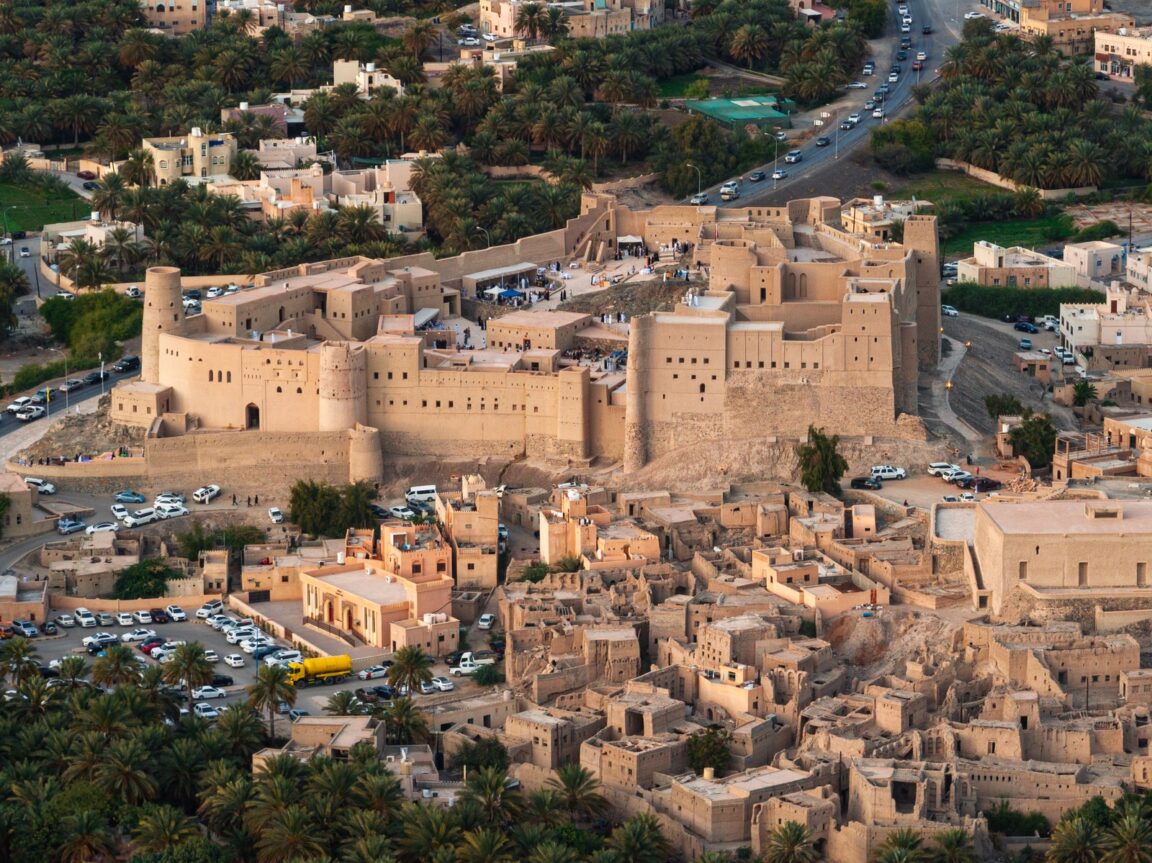
Bahla Fort is the largest and oldest of Oman’s great forts, a vast mud-brick stronghold on stone foundations rising over a palm oasis at the foot of the Jebel Akhdar, and in 1987 it became the first site in Oman inscribed on the UNESCO World Heritage List. Go in the morning, give the fort a full hour or more of climbing and circling, then spend the rest of the day the way Bahla itself does: in the pottery workshops, the old souq and the falaj-fed groves inside one of the longest oasis walls in Arabia, with Jabreen Castle, a short drive away, as the day’s elegant second act.
Quick Facts
Where: Bahla, Ad Dakhiliyah Governorate, Oman, about 210 km from Muscat and roughly 45 km west of Nizwa, at the foot of the Jebel Akhdar highlands.
What: A fortified oasis settlement: the fort, the adjacent Friday Mosque, the old mud-brick settlement quarters, the souq and a perimeter wall, or sur, of about 12 to 13 km enclosing the palm groves.
UNESCO: Inscribed in 1987, Oman’s first World Heritage Site. Listed as in danger in 1988 as rain eroded the mud walls; removed from the danger list in 2004 after restoration in earthen materials.
Hours: Experience Oman, the official tourism portal, lists the fort as open daily from 8 a.m. to 7 p.m., with tickets at the reception desk on site and guided tours on request. No admission price is published on the official page, so check the current fare on arrival.
Best season: October to April, per the official tourism portal.
Pair it with: Jabreen Castle, about 8 km away, and Nizwa, about 45 km east, whose fort and goat market anchor the region.
Why Bahla matters: the fortified oasis, whole
Most forts are a building. Bahla is a system. UNESCO’s Bahla Fort listing describes an immense fort with walls and towers of mud brick on stone foundations, the adjacent Friday Mosque with its sculpted prayer niche, and a mud-walled oasis settlement that owed its prosperity to the Banu Nebhan tribe, who dominated central Oman and made Bahla their capital from the 12th to the end of the 15th century. Around the settlement runs the sur, an extensive wall with a sentry walk, watchtowers and several gateways, enclosing the dwellings and the cultivatable land together. Underneath all of it runs the reason any of it exists: the falaj, the system of wells and underground channels bringing groundwater from distant springs, managed alongside the seasonal flow of water.
UNESCO calls Bahla an outstanding example of a fortified oasis settlement of the medieval Islamic period, and a centre of Ibadism, the branch of Islam on which the ancient Omani Imamates were based. The fort itself is pre-gunpowder work: rounded towers, castellated parapets, and layers from successive periods, with the oldest quarter, Al Qasabah, alongside later houses built in the 17th and 18th centuries. It rewards slow looking. The scale only resolves from a distance, from across the groves, where the whole honey-coloured mass sits on its hill; the detail only resolves inside, in the stairs, passages and courtyards worn by centuries of feet. Travellers who enjoy this kind of layered single-site reading will also get a lot from our Grand Egyptian Museum ticketing guide and the one-morning discipline of our Prado Museum guide.
Visiting the fort: hours, tickets and the climb
The practicalities are refreshingly simple. The Experience Oman page for Bahla Fort, from Oman’s Ministry of Heritage and Tourism, lists the fort as open daily from 8 a.m. to 7 p.m., describes Bahla Fort as a proud Omani legacy and the first UNESCO-listed site in Oman, standing with its mud-brick walls amid lush palm groves, and notes tickets at the reception desk, guided tours on request, and a cafe among the facilities. Because the official page does not publish a price, treat any fee quoted by third-party sites as unconfirmed and simply pay what the desk asks; heritage-site fees in Oman are modest. The same portal recommends October to April, and the reason is heat: Bahla sits inland, away from the coast’s moderating air, and a summer midday on those exposed ramparts is a punishment detail.
Go early anyway, whatever the month. Morning light rakes across the mud brick and gives the walls their colour, the climb is kinder, and you will have the upper levels largely to yourself. Wear shoes with grip: courtyards and stairways are uneven, surfaces are earthen, and the fort’s pleasures are vertical, tower after tower of views over the groves, the old quarters and the long line of the sur. Allow an hour at minimum, ninety minutes if the place takes hold of you. Photography is listed among the fort’s permitted activities on the official profile, which makes Bahla a generous contrast with the no-photography discipline of cave sites such as the Kaiping diaolou route’s interiors in China.
The pottery town inside the walls
Bahla’s second claim on your day is clay. The town is Oman’s historic pottery centre, its workshops turning local clay into the jars, incense burners and vessels that Omani households have used for centuries, fired in traditional kilns. The Discover Bahla visitor site frames the town as a living heritage destination where potters still shape Bahla clay at dawn and the souq wakes beneath an ancient tree, and that rhythm is what to plug into after the fort: workshops first while the potters are working, then the covered souq, then a walk in the old quarters, the harats, where UNESCO notes the traditional mud-brick family compounds, mosques, audience halls and bath houses that grew up in relation to the falaj channels. Watch for water as you walk. The falaj is not a monument here; it is plumbing, still moving, still dividing its shares among the groves by rules older than the fort itself.
Buy pottery at the workshops where you watched it made, and ask how pieces travel before you fall for the largest jar in the room. Bahla pairs naturally with Nizwa, and the two towns together make the interior’s best single day: our Nizwa fort and goat market guide covers the Friday-morning goat market timing that should anchor the whole itinerary if your days align, and museum-minded travellers can extend the heritage thread with our Metropolitan Museum first-visit route on a later trip.
Adding Jabreen Castle, and the order of the day
Jabreen Castle, about 8 km from Bahla, is the fort’s perfect counterpoint. Where Bahla is a fortress that grew over centuries of tribal power, Jabreen was built in the late 17th century under Imam Bil’arab bin Sultan as a palace and a centre of learning, famous for its painted ceilings, carved decoration and the Sun and Moon Room. Doing both in one day teaches you the difference between Omani defence and Omani statecraft, and the drive between them is minutes, not an expedition. Sequence the day as follows: Bahla Fort at opening, while the light and temperature are kind; the pottery workshops and souq late morning; lunch in Bahla or on the road; Jabreen in the afternoon, when its interiors give you shade; and, if you are based in Nizwa, the evening there. Drivers coming from Muscat should treat the whole loop, Muscat to Bahla to Jabreen to Nizwa and back, as a long but entirely feasible day, with the fort first, because its 7 p.m. close is not the binding constraint; the heat and the light are.
The danger years, and why the walls look the way they do
Bahla’s modern story is a conservation lesson. Mud brick is a superb building material in a dry climate and a fragile one in the rain, and by the 1980s the fort’s earthen walls were deteriorating badly enough that UNESCO placed the site on the List of World Heritage in Danger in 1988, a year after inscription. The restoration that followed, carried out with traditional earthen materials and techniques rather than concrete, returned the fort to stability, and the site came off the danger list in 2004. That history is visible as you walk: renewed sections read slightly differently from weathered original fabric, and the fort you climb today is honestly presented as a maintained earthen building, not a stone castle pretending to be permanent. It is also why the site asks visitors to treat surfaces gently. Every hand on a mud-brick parapet is, in aggregate, a conservation decision.
Frequently Asked Questions
How much does it cost to enter Bahla Fort?
The official Experience Oman page does not publish an admission price; tickets are sold at the reception desk on site. Ignore precise fees quoted on third-party sites, which conflict with each other, and check the current fare on arrival.
What are Bahla Fort’s opening hours?
Experience Oman lists the fort as open daily from 8 a.m. to 7 p.m. Confirm on the official page before you travel, as heritage-site arrangements can change.
Why is Bahla a UNESCO World Heritage Site?
Inscribed in 1987 as an outstanding example of a fortified oasis settlement of the medieval Islamic period: the mud-brick fort, Friday Mosque, walled settlement and falaj water system of the Banu Nebhan capital, and Oman’s first World Heritage inscription.
How long should I spend at Bahla?
An hour to ninety minutes inside the fort, plus time for the pottery workshops, the souq and the old quarters. With Jabreen Castle added, Bahla comfortably fills a day from Nizwa or a long day from Muscat.
What is the best time of year to visit Bahla?
October to April, per the official tourism portal. Inland Oman is fiercely hot in summer, and the fort’s exposed walls and towers offer little shade at midday.
Featured image: Bahla Fort’s mud-brick towers above the palm oasis, via Experience Oman (experienceoman.om), Oman’s official tourism portal.