 Aiko Tanaka
Measure your suitcase before you book your seat, because on Japan’s busiest bullet train lines the size of your bag decides which seat you are allowed to sit in. On the Tokaido, Sanyo, Kyushu and Nishi-Kyushu Shinkansen, a bag whose length, width and height add up to more than 160 cm is classed as oversized baggage, and it may only travel with a reserved seat that comes with an oversized baggage area, usually the last row of the car. The reservation costs nothing extra. Board with an oversized bag and no reservation and the conductor charges a 1,000 yen fee and decides where the bag goes. A bag totalling over 250 cm cannot come on board at all. This guide works through the full luggage picture: the size bands, where each kind of bag physically goes on the train, how to book the right seat, how luggage forwarding removes the problem entirely, and how to find your car, your seat and your exit in Japan’s biggest stations without losing the plot or the train.
Quick Facts
The threshold: Total dimensions, length plus width plus height including wheels and handles, over 160 cm make a bag oversized.
The ceiling: Bags over 250 cm in total dimensions are not accepted on board at all.
The seat: Reserve a seat with an oversized baggage area, normally the last row of the car. It costs the same as any other reserved seat.
The penalty: Boarding with an oversized bag without the reservation costs 1,000 yen including tax, collected on board.
Where the rule applies: Tokaido, Sanyo, Kyushu and Nishi-Kyushu Shinkansen. JR East and JR Hokkaido lines run under their own guidance and do not use this reservation system.
The general allowance: Up to two pieces of baggage per passenger, each up to 30 kg, under JR’s general carrying rules.
Last checked: 25 November 2026.
The Three Size Bands, and How to Measure Honestly
Everything starts with one measurement. Take the longest side of your case, its width and its depth, measure the outside including wheels, handles and anything rigid that sticks out, and add the three numbers. JR Central’s official oversized baggage page sets the bands plainly: at 160 cm or less your bag is ordinary luggage and needs no reservation; between 161 and 250 cm it is oversized and the seat reservation rule applies; above 250 cm it cannot travel on the train. The trap is that a standard large check-in suitcase, the size airlines happily accept, often lands just over the line: a case measuring 80 by 55 by 32 cm totals 167 cm and needs the special seat. A medium case usually totals under 160 and does not. If your measurement lands within a centimetre or two of 160, book the oversized seat anyway. It costs nothing, and arguing with a tape measure on a platform helps nobody.
Our earlier explainer on the oversized baggage reservation and the fine at the gate covers the enforcement story in depth. This guide takes the wider view: the reservation is only one of four places your bag can go, and for many travellers it is not even the best one.
Where Bags Actually Go on the Train
There are four storage answers on a shinkansen, and knowing all four ends most luggage stress. The overhead rack runs the length of the car and is roughly 42 cm deep, which swallows cabin bags and medium cases up to the 160 cm band, provided you can lift them. The space at your feet handles a daypack and a soft bag. Many cars also have a deck baggage storage area in the vestibule, a lockable shelf unit for larger bags within the ordinary size band, secured with an IC card. The fourth space is the oversized baggage area, the floor area behind the last row of seats in designated cars, shared between the passengers who reserved those back-row seats, plus the lockable oversized baggage compartments fitted to some newer cars, which are booked with the matching seat.
Two practical consequences follow. First, unreserved cars have no oversized baggage seats, so a traveller with a big case cannot simply buy the cheapest unreserved ticket and hope. Second, supply is limited: on a 16-car Tokaido train only a few dozen seats carry the baggage area, and they sell out on holiday weekends and during the New Year, Golden Week and Obon peaks. Book the seat when you book the journey, not the day before. Booking channels include SmartEX, JR Central and JR West’s official booking service, the JR West and JR Kyushu online reservation services, station ticket machines and ticket counters, where the instruction to give staff is explicit: you are bringing oversized baggage and need the seat that goes with it.
The Alternative That Beats the System: Forward Your Bag
Japan’s luggage forwarding services, the takkyubin courier network, exist precisely because trains and big suitcases mix badly. You hand the case over at a hotel desk, a convenience store counter or an airport service counter, and it arrives at your next hotel, usually the following day, for a fee that depends on size and distance. Travellers ride the shinkansen with a daypack, walk their destination station unencumbered, and find the case waiting at check-in. The Japan National Tourism Organization’s luggage guidance outlines the forwarding system and the station coin lockers and luggage counters that fill the gaps, and it is the single most useful page a first-time visitor with a big case can read before departure. Forwarding also solves the over-250 cm problem outright: a bag too large for the train is a routine parcel for a courier. The one discipline forwarding demands is planning one day ahead, so pack the overnight essentials, medication and a change of clothes in the bag you carry.
Packing light enough to use the overhead rack is the other permanent fix, and the system in our guide to carry-on only travel for two weeks in Asia was built for exactly this railway: a carry-on sized case never triggers the reservation rule, never needs forwarding, and never has to be lifted into a vestibule shelf in a crowded aisle.
Station Navigation: Finding Your Train in the Big Stations
The shinkansen does not leave from a platform you stumble onto; it leaves from a separate station within the station, behind its own ticket gates. At Tokyo Station, the country’s biggest rail hub, the shinkansen gates sit on the Marunouchi side of a complex that also holds dozens of local lines, and the walk from some entrances to the Tokaido platforms runs to ten minutes or more. The method that works everywhere is the same: follow the signs for the shinkansen transfer or entrance gates in the line’s colour, pass through the shinkansen gate with your ticket or IC card plus reservation, then read the departure board for your train’s name and number, because platforms are assigned by train, and only then go up to the platform. Car numbers are painted on the platform floor and shown on the hanging signs, and your reserved car number is on your ticket. Stand at your car marker before the train arrives; boarding windows are short and the doors are exactly where the markers say.
Build your itinerary around the stations rather than through them. Our five-day Tokyo district itinerary keeps arrival and departure days light for this reason, and our three days in Kyoto with crowd avoidance shows how to time a shinkansen arrival into a sightseeing day without wasting the afternoon. At Kyoto Station and Shin-Osaka, the same gate-then-board-then-car-marker sequence applies, and the central transfer gates between shinkansen and local lines are signed in English throughout. If you are changing to a local train, allow ten minutes at big stations and never schedule a tight connection with an oversized bag in tow. Travellers heading onward to a second Tokyo stay can also use our second-visit Tokyo itinerary to plan which station, Tokyo or Shinagawa, suits the next leg: Shinagawa is the calmer, simpler shinkansen stop for the Tokaido line and often the kinder choice with luggage.
Frequently Asked Questions
Does the oversized baggage rule apply on every shinkansen line?
No. The reservation system applies on the Tokaido, Sanyo, Kyushu and Nishi-Kyushu Shinkansen. The Tohoku, Hokkaido, Joetsu and Hokuriku lines run by JR East and JR Hokkaido do not require the oversized baggage seat reservation, though their general size and weight limits still apply.
How much does the oversized baggage seat cost?
Nothing extra. A seat with an oversized baggage area is priced the same as any other reserved seat in the same class. You are reserving space, not buying an upgrade.
What happens if the oversized baggage seats are sold out?
You have three honest options: travel on a different departure, forward the bag by courier and travel light, or downsize the bag. Boarding anyway costs 1,000 yen if the conductor allows it, and there may simply be nowhere for the case to go.
Can I use a Japan Rail Pass with an oversized bag?
Yes, but the pass does not waive the rule. Pass holders reserve the oversized baggage seat through the pass reservation channels or at a ticket counter, at no extra charge, before boarding.
Are strollers and sports equipment treated the same way?
No. JR’s guidance treats items such as strollers, sports gear and musical instruments under their own provisions, and some fold or pack within the ordinary bands. Check the operator’s luggage page for your specific item before you travel.
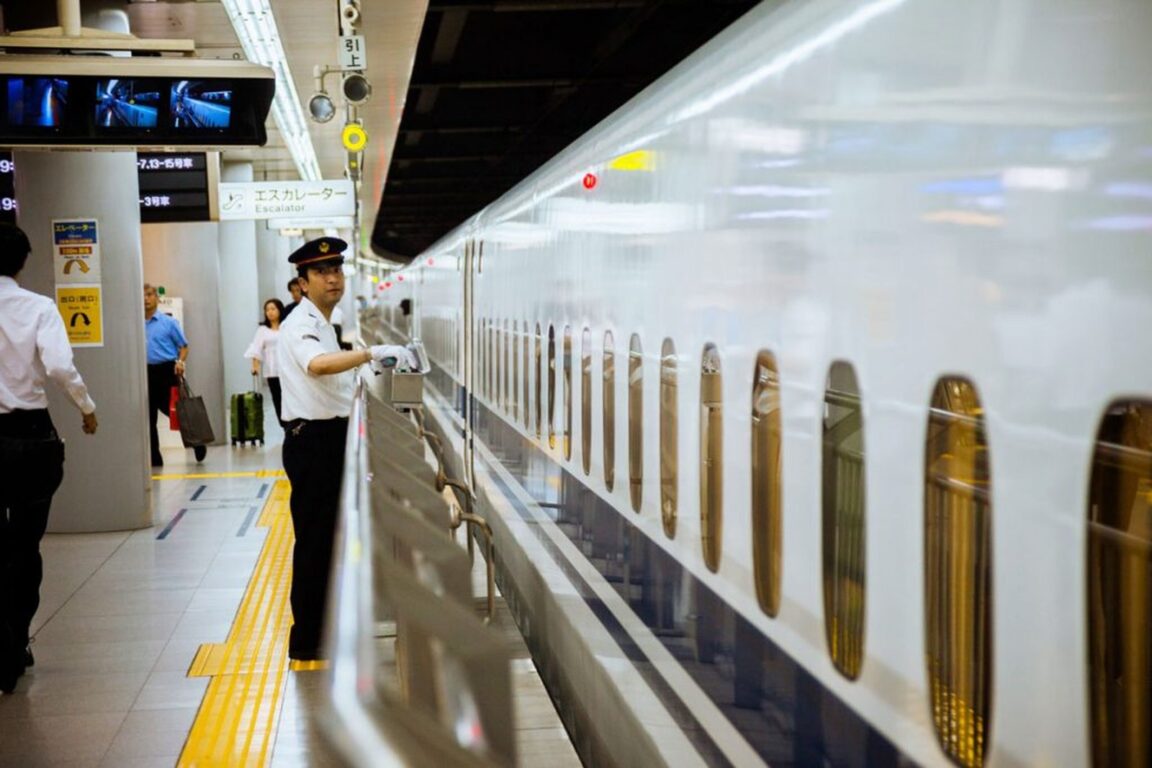
Image: A shinkansen at a station platform in Japan, with a conductor on duty beside the train. Credit: Vistoriano Izquierdo, via Unsplash (Unsplash License). File obtained at 1024px wide and resized to exactly 1600px wide.
Facts checked 25 November 2026 against JR Central’s official oversized baggage guidance, SmartEX and the Japan National Tourism Organization.