 Kwame Mensah
Choose a guided tour for your first one or two nights in Whitehorse, then judge the do-it-alone option honestly once you know the sky. That is the short answer for most travellers. Whitehorse sits at about 60.7 degrees north, on the southern edge of the auroral oval, and Travel Yukon’s northern lights guide puts the viewing season from mid-August to mid-April, with the best hours between 10 p.m. and 3 a.m. A tour buys you a heated viewing site away from city light, a driver who watches the forecasts so you do not have to, and transport on icy roads at 1 a.m. Going alone buys you freedom: your own cabin, your own schedule, and no group timetable. Neither option changes the aurora itself, and no operator can guarantee a display.
Quick Facts
Base: Whitehorse, Yukon, Canada, at about 60.7 degrees north, under the auroral oval.
Season: Mid-August to mid-April, per Travel Yukon. Autumn runs mid-August to mid-October; winter runs mid-October to early April.
Best hours: 10 p.m. to 3 a.m., per Travel Yukon.
How many nights: Travel Yukon recommends at least three nights to improve the odds of a clear, active sky.
Activity benchmark: A Kp index of 3 or higher is generally enough for a good show in Whitehorse, per Destination Canada.
Getting there: Erik Nielsen Whitehorse International Airport is about 10 minutes from downtown; Air North and Air Canada fly from Vancouver in about 2.5 hours.
Guarantee: None exists. Aurora activity and cloud cover decide the night, whichever option you choose.
What a guided Whitehorse tour actually buys you
The standard Whitehorse model, as Travel Yukon describes it, is simple: operators collect guests from downtown hotels and drive them to custom-built viewing sites for a few hours, with heated tents or yurts and a campfire. That structure solves the three problems that ruin most first attempts. The first is light. A strong aurora shows even from inside the city, but streetlights wash out weaker displays, and a viewing site a few kilometres out keeps the whole sky readable. The second is cold. Winter nights in the Yukon regularly fall far below freezing, and a heated shelter turns a four-hour wait from an endurance test into a pleasant evening of stepping out when the sky moves and stepping back in when it rests. The third is judgment. Guides read the solar and cloud forecasts nightly, and they know which clearings stay dark and which roads ice first.
A tour also fits the trip architecture most visitors actually have. If you are basing yourself in a downtown hotel, in the pattern our Dawson City and Klondike guide recommends for a Yukon road trip, a pickup tour means nobody in your group has to be the sober, alert driver on a dark highway at the end of the night. The trade-offs are real, though. You watch on the operator’s schedule, typically a fixed window of a few hours. You share the site with a group. And if the sky explodes at 4 a.m., after the bus has gone back to town, you will hear about it at breakfast.
What going it alone actually involves
The independent version of this trip usually means renting a cabin or a rural property outside Whitehorse, or driving yourself to dark sites each night. Done well, it is wonderful. You can watch from a hot tub or a cabin deck, sleep in short shifts, set an alarm for the small hours, and stay out for exactly as long as the display lasts. Travellers who have already seen the lights elsewhere, including readers coming from an Iceland northern lights trip planned around the daylight trade-off, often prefer this control.
Done casually, it fails in predictable ways. You need a rental car you are comfortable driving on snow and ice, in the dark, in serious cold. You need to choose your own viewing spots, and the honest local advice is unglamorous: get a few kilometres out of town, away from streetlights, and face north. You need to read two forecasts, not one. The aurora forecast tells you whether the lights are likely to be active; the cloud forecast tells you whether you will see the sky at all, and in Whitehorse the second one fails more trips than the first. Destination Canada’s Whitehorse aurora guide points travellers to the NOAA Space Weather Prediction Center’s aurora dashboard for tonight-and-tomorrow visibility forecasts, and notes that a Kp of 3 or higher typically pushes the oval overhead here. You also need the discipline to dress for standing still outdoors at minus 20 or colder, in layers, with proper boots, because aurora watching is mostly standing still.
The odds, month by month
Travel Yukon splits the season in two, and the split matters more than any single month ranking. Autumn, from mid-August to mid-October, brings milder weather and, early in the season, lakes that have not frozen, so a calm night can reflect the lights in open water. The cost is shorter darkness: in late August the night is brief, and your viewing window compresses toward the middle of it. Winter, from mid-October to early April, brings the longest and darkest nights, which is why it is the main viewing season, and also the coldest temperatures of the year. Late March into mid-April shortens the nights again but softens the cold.
Two refinements are worth planning around. Displays tend to strengthen around the equinoxes, in late September and late March, a pattern NOAA’s space weather guidance supports and one reason autumn and early spring trips punch above their weight. And the moon matters: a full moon washes out faint aurora, so a trip built around the new moon gives weak displays a fair chance. This is the same arithmetic behind our best time to visit Iceland guidance, and it transfers directly. What does not transfer is any promise. Solar Cycle 25 reached its maximum in October 2024, per NASA and NOAA, and activity can stay strong in the years after a peak, which makes the current seasons promising. Promising is not certain, and the three-night minimum exists precisely because cloud, not solar activity, is the usual spoiler. Travellers comparing northern bases should also read how Akureyri works as a quieter northern lights base and how the season runs in Churchill, Manitoba, where aurora season overlaps the polar bear calendar.
The hybrid plan most travellers should book
Book a guided tour for your first night, or your first two nights of a longer stay. You will learn the local sky, the realistic timing, and how cold the waiting actually feels, with a heated shelter as your safety net. Then take your remaining nights independently if you have a car and a dark base: a cabin outside town, or a rural stay where the lights can appear over your own roof. Build the days around the nights. Whitehorse rewards slow daytime plans in aurora season: the S.S. Klondike, the Yukon Wildlife Preserve and a soak at the hot springs outside town all work, and the springs pair naturally with a night schedule. If your trip is only two nights, skip the hybrid and tour both nights; the sample size is too small to spend one of them learning. If it is four or five nights, the mix gives you both the highest-probability nights and the freedom nights, and a stop at Banff’s Upper Hot Springs on a wider Canadian winter route makes a fine warm counterpoint before or after.
Whichever way you split it, check the practicalities on Travel Yukon’s northern lights pages before you book, keep at least one spare evening in hand for weather, and pack as if the best night of your trip will be the coldest. In the Yukon, it usually is.
Frequently Asked Questions
When is the best month to see the northern lights in Whitehorse?
There is no single best month. Winter, from November to March, offers the longest and darkest nights; late September and late March benefit from stronger activity around the equinoxes; and August to October is milder. Travel Yukon’s season runs mid-August to mid-April, and any trip inside it should last at least three nights.
Can you see the aurora from Whitehorse itself?
Yes, during a strong display, but city light washes out weaker aurora. A few kilometres out of town, facing north under a dark sky, is the reliable standard, which is exactly what guided viewing sites provide.
What Kp index do you need in Whitehorse?
Destination Canada notes that a Kp of 3 or higher is generally enough for a good show in Whitehorse, because the city sits near the auroral oval. Cloud cover still decides whether you see it.
Is a tour worth it if I have a rental car?
For the first night, usually yes: the heated site, the local forecast judgment and not driving icy roads at 1 a.m. all have real value. On later nights, a car and a dark cabin base can be the better experience.
How cold does aurora watching get?
Winter nights can fall to minus 30 Celsius or colder in the Yukon. Dress for standing still, not for walking: insulated boots, layered clothing, a warm hat and gloves, and a plan to warm up between displays.
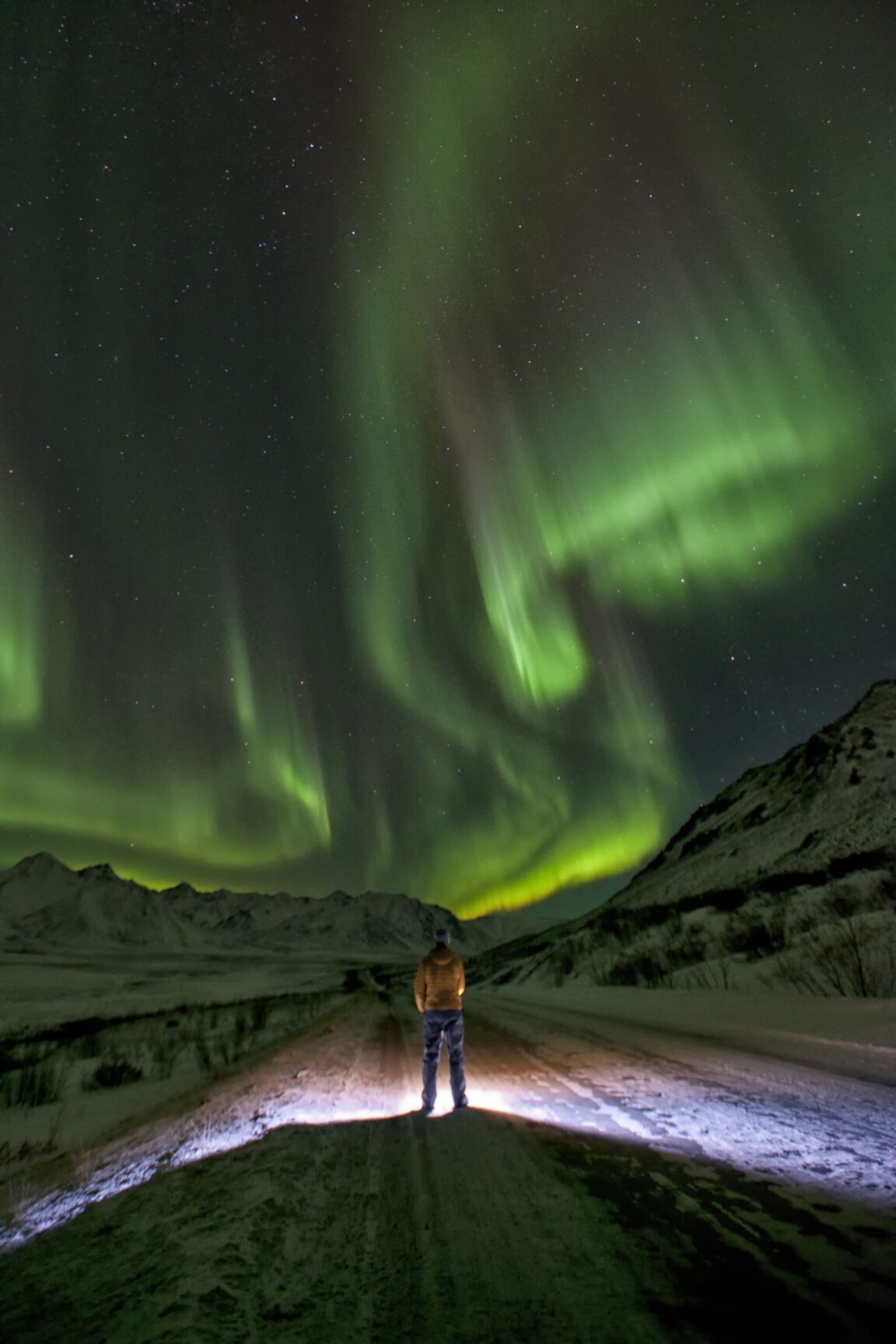
Featured image: A person standing under the northern lights in the Yukon, by P. Mather, via Travel Yukon (travelyukon.com), the Yukon’s official tourism authority.