 Aiko Tanaka
A first onsen is simpler than it looks from the doorway: you wash thoroughly at the shower stations before you touch the bath water, you bathe naked, you keep your towel and your hair out of the water, and you soak quietly. That is the whole core of onsen etiquette, and every other rule is a variation on keeping the shared water clean and the room calm. Tattoos are the one genuine complication. No Japanese law bans tattooed bathers, but each facility sets its own house rule, and the last nationwide government survey found roughly 56 percent of inns with baths refused tattooed guests, about 31 percent accepted them and about 13 percent accepted them with conditions such as a cover patch. The beginner’s strategy is therefore twofold: learn the bathing sequence until it is automatic, and choose towns and inns whose tattoo policy is published and welcoming before you travel.
Quick Facts
The core rule: Wash your whole body at the shower stations before entering the bath. The bath is for soaking, never for cleaning.
The dress code: Naked, in gender-separated baths, at almost every traditional onsen and sento. Swimwear belongs to pools and mixed leisure facilities, not the communal bath.
The towel rule: Your small towel comes to the bath edge but never goes in the water. Leave it on the side, or folded on your head, the classic local solution.
The tattoo position: No national law and no national ban. Each facility decides. A Japan Tourism Agency survey of 581 responding facilities found 56 percent refused tattoos, 31 percent did not refuse and 13 percent allowed entry under conditions.
The official steer: In 2016 the Japan Tourism Agency told the industry that refusing a bather solely for a tattoo is not appropriate, and suggested cover stickers, quieter hours and private baths as workable alternatives. It is guidance, not law.
The beginner’s shortcut: A private or in-room bath removes the tattoo question entirely, because no other bathers are present.
Last checked: 25 November 2026.
The Bathing Sequence, Step by Step
Arrive, take off your shoes at the entrance, pay or register, and find the curtain for your bath: blue for men, red for women, marked with the character for hot water. In the changing room everything comes off. You take in only the small towel provided or sold at the desk, leaving the large towel with your clothes. Inside the bath hall, take a stool and a basin to a free shower station, rinse the stool, sit down, and wash completely: hair, body, everything, staying seated so you do not spray your neighbours. Rinse every trace of soap off your body, rinse the stool and your spot clean for the next person, and only then walk to the bath. Ease in slowly, because onsen water commonly runs between about 40 and 44 degrees Celsius, and let your body adjust before you settle. The Japan National Tourism Organization’s onsen guidance walks through the same sequence for first-time visitors, and the order never really varies from Hokkaido to Kyushu.
While soaking, keep the rules of the room: no swimming, no splashing, no towel in the water, hair tied up and out of the bath, voices low. When you leave, most regulars do not rinse the mineral water off, believing the spring’s minerals are the point; a light pat dry, then dress and rest. The Japanese Ministry of the Environment, which oversees hot spring standards, publishes bathing guidance that adds the health layer: hydrate before and after, avoid bathing straight after meals or alcohol, get out if you feel dizzy, and take the water in shorter soaks with rests between, especially on a first visit. Ten unhurried minutes at a time is a better first onsen than one heroic half hour.
Tattoos: What the Rules Actually Are
The tattoo question has a legal answer and a practical answer, and they differ. Legally, nothing in Japanese national law bans a tattooed person from a bath. The refusal tradition is a house rule with historical roots in keeping organised crime members out of communal spaces, maintained today by individual operators. Practically, the Japan Tourism Agency’s 2015 survey remains the only nationwide count: of 581 facilities that responded, about 56 percent refused tattooed bathers, about 31 percent did not refuse them and about 13 percent allowed entry under conditions. The agency’s follow-up guidance in March 2016 asked the industry to stop refusing people solely for tattoos and proposed the tools you will still meet at front desks now: skin-coloured cover stickers for smaller tattoos, admission at quieter hours, and private baths. None of that binds any individual inn, which is why the only reliable method is to check the specific facility’s published policy or ask before booking, and to accept a no gracefully when it comes. Cover stickers are sold in Japanese drugstores and at some front desks, but a sticker only works where the policy accepts covered tattoos, and only up to the size the house allows.
The trend, town by town, is toward welcome, and some famous onsen towns have made acceptance a civic position. Kinosaki Onsen in Hyogo is the standard example: its seven public baths famously welcome tattooed bathers, and the town’s whole visitor model is built around strolling between baths in a yukata. You can plan a Kinosaki stay through the town’s official visitor site at Visit Kinosaki, which lists the baths and the ryokan that anchor the town. Kusatsu and Beppu are also widely known for more relaxed attitudes in many of their public baths, though individual facilities still vary, and Tokyo’s neighbourhood sento are generally more relaxed than rural ryokan baths. Where a tattoo is large or a policy is strict, the private bath is the dignified answer rather than an argument at the desk.
Beginner-Friendly Towns to Start With
Choose your first onsen town for forgiveness as much as for water quality. Kinosaki is the gentlest introduction in the country: seven public baths within a short stroll, a town that expects foreign first-timers, English signage, and the tattoo welcome described above. Hakone, in the hills within easy reach of Tokyo, offers the deepest bench of ryokan with private in-room baths and reservable family baths, which is why our guide to Hakone ryokan with private onsen rooms is the natural companion to this one if privacy is your priority. Nikko pairs its shrines with ryokan bathing in a rhythm our Nikko ryokan stay guide lays out day by day. Kyoto’s in-town sento and the ryokan tradition covered in our profile of Hiiragiya Ryokan suit travellers who want bathing woven into a city stay, and our Kyoto guide for solo women travellers covers the evening bath-and-bus logistics from a solo perspective. Takayama’s old town ryokan, in the setting of our Takayama morning markets guide, round out a beginner list that never requires you to be an expert before you arrive.
One more piece of beginner craft: learn the two towels. The large towel stays in the changing room. The small towel washes you, carries your modesty on the walk to the bath, and then waits on the bath edge or on your head. Facilities rent or sell sets cheaply, day-bathing at public baths is inexpensive, and bringing a small sealable bag for the wet towel afterwards marks you out as someone who has done this before, even the first time.
Frequently Asked Questions
Can I wear a swimsuit in an onsen?
Not in a traditional communal bath, where bathing is naked and gender-separated. Swimwear appears at pools, mixed leisure onsen parks and some modern facilities that say so explicitly. If modesty is the concern, a private bath solves it completely.
What do I do with a large tattoo?
Do not rely on a cover sticker, which houses accept only for smaller tattoos and only where their policy allows covered entry. Choose a facility that publishes a tattoo-welcome policy, a town such as Kinosaki whose public baths accept tattoos, or a private or in-room bath.
How hot is onsen water, and how long should I stay in?
Most baths run around 40 to 44 degrees Celsius, with some famous springs hotter at the source. Begin with soaks of about ten minutes, rest and hydrate between them, and never stay in through dizziness. The water is the therapy and the risk at the same time.
Can children use onsen?
Yes, children bathe with a parent in the matching bath at most facilities, and the same washing rules apply to them. Keep them close, keep them calm, and choose the cooler bath where a facility offers a range of temperatures.
Is it rude to rinse off after the bath?
No, it is a preference, not a rule. Many regulars leave the mineral water on their skin; travellers with sensitive skin often rinse lightly. Either is acceptable. What matters is everything that happens before you get in.
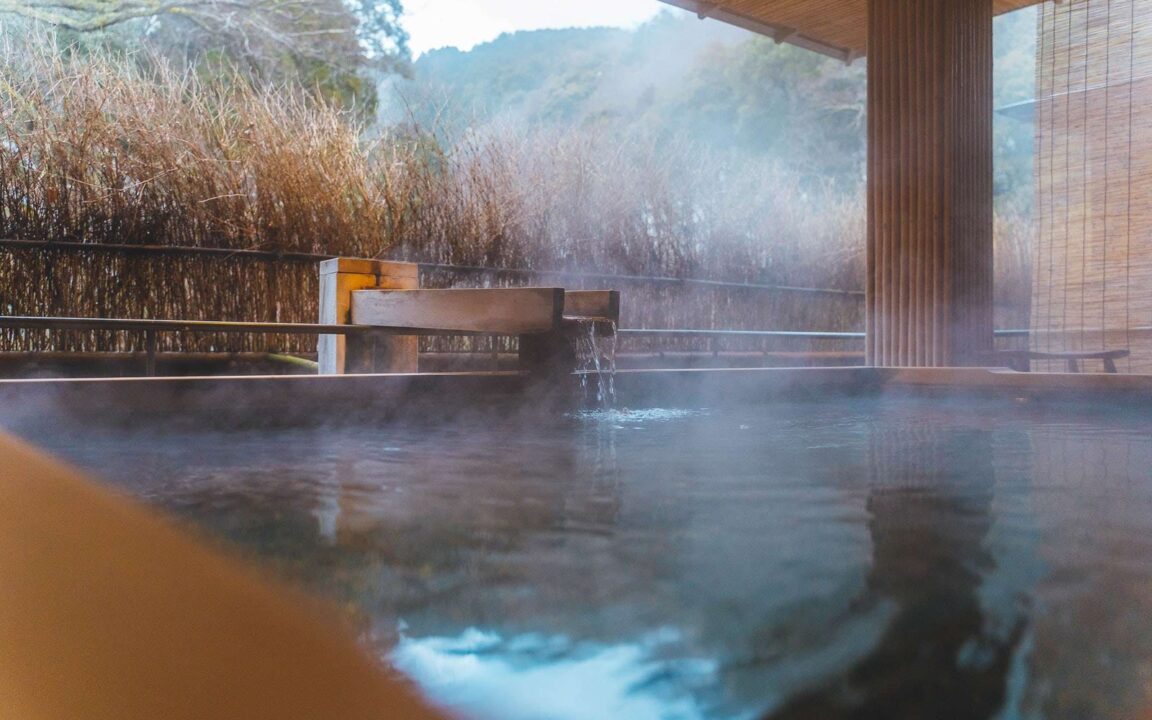
Image: Steam rising from an outdoor onsen bath in Japan, with hot spring water flowing into the pool. Credit: Romeo A., via Unsplash (unsplash.com/photos/8X3IMf4W8Ew), Unsplash License. Resized to exactly 1600px wide.
Facts checked 25 November 2026 against the Japan Tourism Agency’s tattoo survey and 2016 industry guidance, the Japan National Tourism Organization and Japan’s Ministry of the Environment bathing guidance.